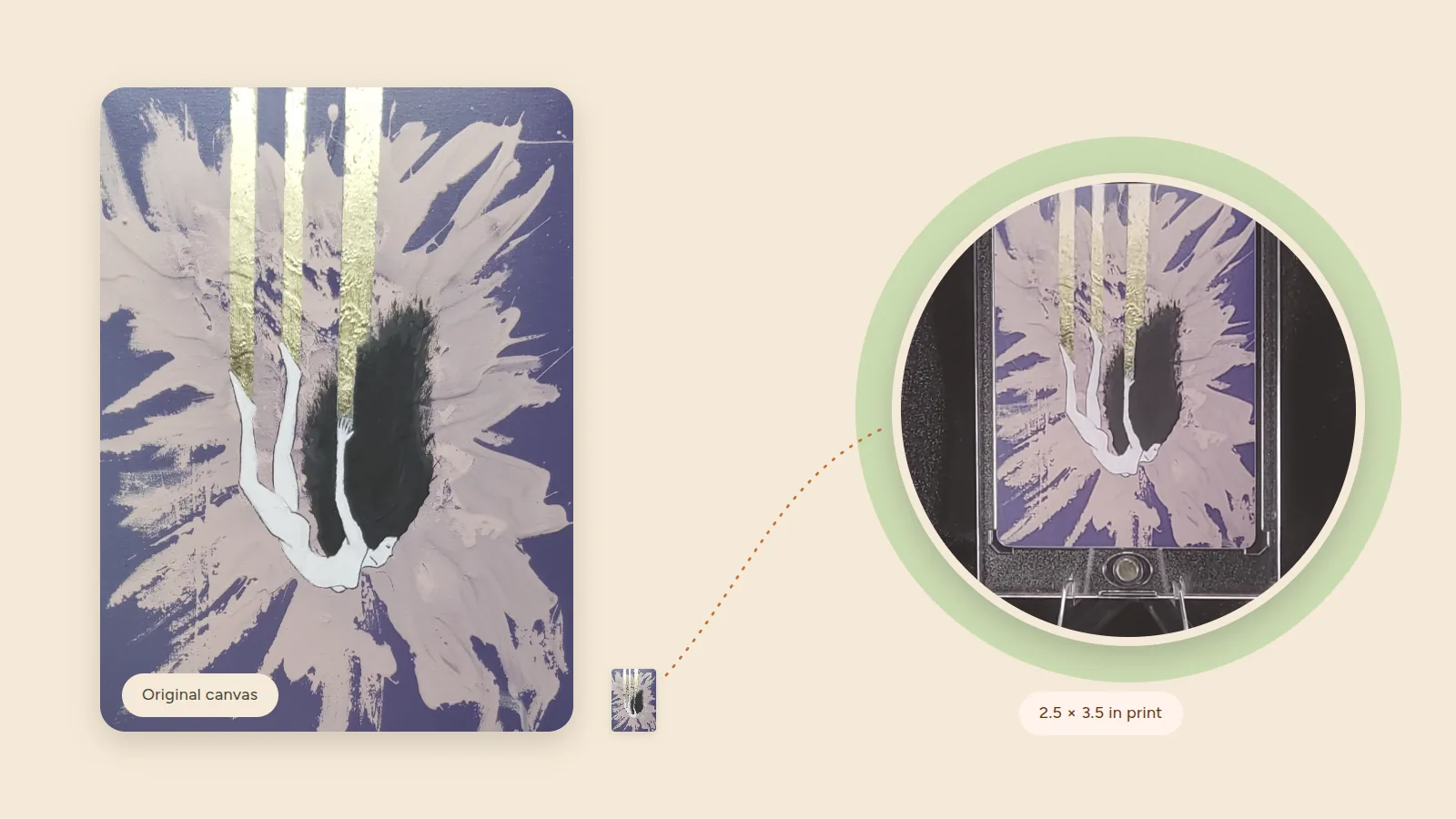
Not every painting earns its reduction. When you compress a 24×36-inch canvas to 2.5×3.5 inches, most works lose whatever made them worth looking at. The detail that anchored a composition disappears. The color relationships that worked at scale collapse into a muddied approximation. The viewer ends up staring at a record of a painting rather than the painting itself.
The six works in Minicuration's inaugural collection were chosen specifically because they don't do this. Each was selected after looking at what actually survives the shrink — which turned out to be a more interesting question than it first appears, because what survives and what is lost depends heavily on what kind of painting it is to begin with.
What Gets Lost When a Painting Shrinks
The first casualty is texture. JFeelgood works in materials that build physical surface — joint compound, crackle medium, palette knife impasto, found objects set in epoxy resin. At full size, the viewer's eye reads the light catching a raised edge, the shadow pooling in a groove. At card scale, that three-dimensionality has to be printed flat onto archival card stock. The texture is gone.
The second casualty is density. A painting loaded with detail — figures, architectural elements, intricate mark-making — becomes illegible when compressed. The viewer's eye can't parse it at 2.5 inches. What read as rich at full size reads as busy or confused at card scale.
What survives compression, reliably, is color contrast, compositional silhouette, and emotional directness. A work that leads with those three things — before it leads with detail, before it leads with textural complexity — tends to earn its reduction. The six Minicuration prints are, each in a different way, examples of this.
The Test
A painting earns its reduction to card scale if, at 2.5 × 3.5 inches, something in the image still requires attention. Not recognition. Not appreciation. Attention — the involuntary kind.
The Six Works, Individually
Each of the six prints in the collection survives for a different reason. Understanding why tells you something about both the paintings and what small-format art can and cannot do.
Dreamfall
Acrylic, Spray Paint, Ink, Gold Leaf on Canvas
"I wanted to paint what it felt to be near beauty."
Dream Mountain
Acrylic on Canvas
"I want to show you the hills and valleys of my imagination."
Sky Miles
Acrylic, Latex, Epoxy Resin, Chrome Airplane Model on Canvas
"Navigating emotions is to know the water from the winds."
A Simple Meditation
Acrylic on Canvas — painted in 10 minutes, no brushes
"Faster than the influence of intention."
Veritas
Acrylic on Canvas
"One can begin to lose themselves in presenting for others."
Sweet Dreams
Acrylic, Joint Compound, Spray Paint on Wood Panel
"Secret garden, sweetest dream."
Dreamfall works because of the gold leaf trailing behind the falling figure. At full size, that detail reads as craft. At card scale, it reads as light — a streak of warmth against a dark background that the eye goes to immediately, and then finds the figure. The compositional logic doesn't change with the size. It just concentrates.
Dream Mountain is the most abstract piece in the collection, built from dense impasto dabs of color that form an imagined landscape. What makes it work small is the same thing that makes Impressionism legible at distance: the colors are doing compositional work, not decorative work. The eye organizes them into a scene even when individual brushstrokes are too small to resolve. At card scale, the painting becomes slightly more unified than it is at full size — a rare case where compression helps.
Sky Miles is the technically unusual entry. The original painting has a chrome airplane model physically embedded in epoxy resin on the canvas — a three-dimensional object set into a two-dimensional surface. At full size, the model's reflection catches studio light and reads differently from every angle. The print necessarily collapses this into a fixed representation of one viewing angle. What saves it is the epoxy pour itself: the swirling fluid motion of the resin, photographed from the right angle, reads as movement even when flat. The print captures a moment inside a process that the original is always escaping.
A Simple Meditation has the simplest explanation: it was painted to be immediate. JFeelgood's stated constraint for this piece was ten minutes, no brushes — paint applied directly from tubes and by hand, with no time for compositional calculation. The result is a painting with a single focal point (a seated figure, a cup) and a lot of open space. There's no competing density. The eye knows where to go at any scale.
Veritas is the only work in the collection where the figure reads differently small than it does large. At full size, the painting's central subject — a woman in a flowing garment, rendered with translucent acrylic over an abstracted background — carries a specific emotional weight. At card scale, the translucency flattens slightly, and the figure becomes more graphic, more silhouette. It's a different reading of the same image, not a diminished one. The concept — about the performance of identity, about losing yourself in presenting for others — doesn't require the full-scale painting to communicate. The silhouette alone carries it.
Sweet Dreams leads with contrast: a dark female silhouette against stylized trees with red flower-dots, a textured sky behind. Joint compound built into the wood panel gives the original a raised surface that prints as tonal depth — the texture is gone, but the color reading that the texture created (light vs. shadow, warm vs. cool) survives. The high-contrast graphic structure does the rest. At card scale, Sweet Dreams looks almost deliberately designed for the format, even though it was painted at 24×36 on wood.
What This Means for Collecting
"The six prints in this collection range from intimate meditations to large-feeling landscapes compressed to card scale. Each one was chosen because it does something that doesn't survive shrinking — and then it does."
Minicuration's selection criteria weren't about which paintings were the most critically successful or the most technically complex. They were about which paintings remained paintings at 2.5 × 3.5 inches — which ones still had something to say when the physical texture was gone, when the scale relationship between viewer and canvas was eliminated, when the image had to stand entirely on color, composition, and the emotional directness of the original idea.
All six passed that test. The fact that they passed for different reasons — immediacy in one case, graphic structure in another, compositional logic in a third — is what makes the collection coherent rather than arbitrary. They're not six random works by the same artist. They're six different proofs of the same argument: that a painting built around a genuine idea survives reduction in a way that a painting built around technique or detail does not.
The full collection is available at the Minicuration shop. All six prints, 50 editions each, all on sale at $10 (regularly $23). The artist's statement on the back of each card tells the story behind the work — the medium, the constraint, the concept. That part doesn't compress.