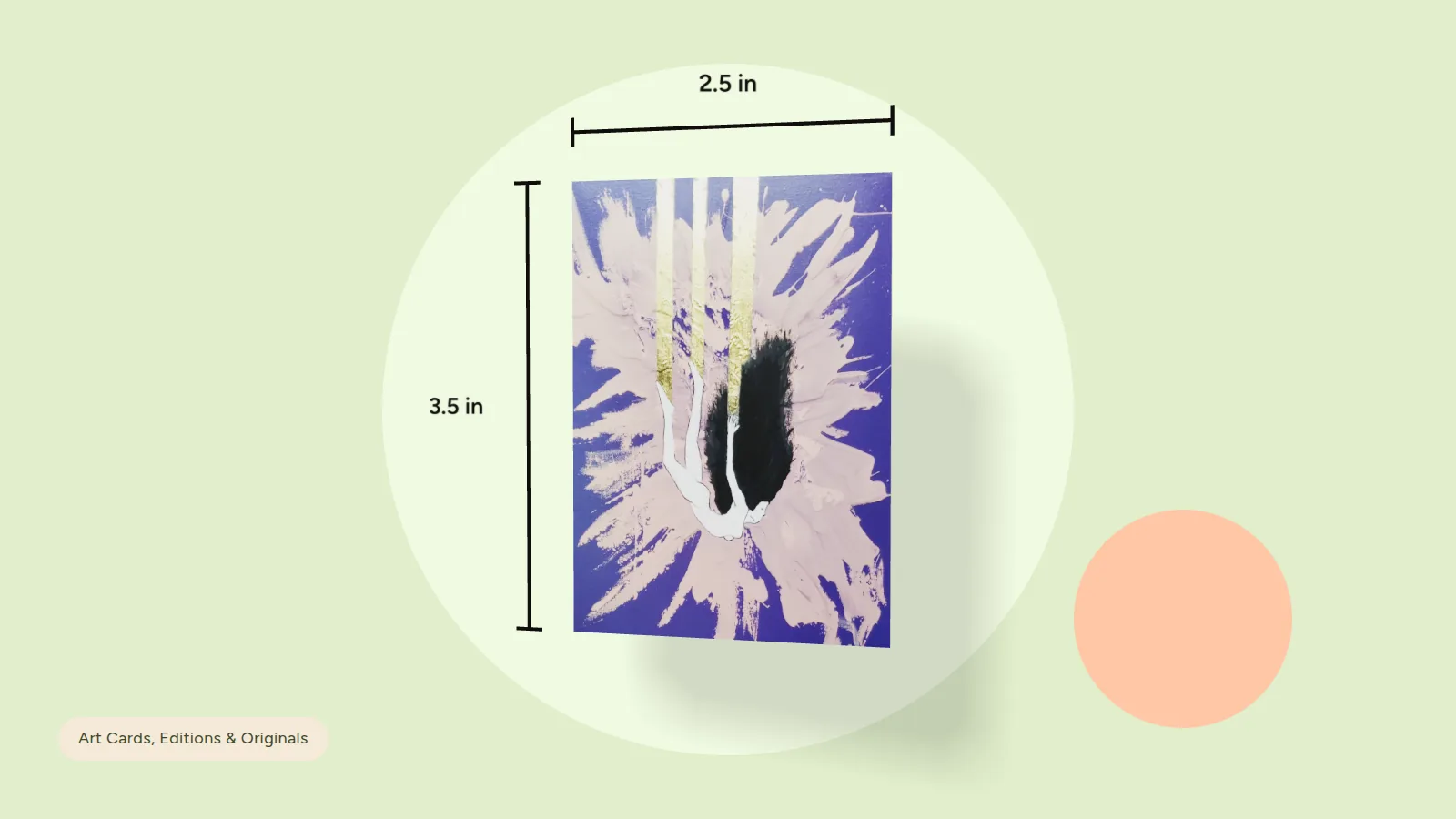
The ACEO format has a stranger, more specific origin than most collectors expect. It didn't emerge from galleries or auction houses. It came from eBay, where artist Lisa Luree started a category for miniature artworks — original paintings, drawings, and prints — listed at a standard trading card size so they could be stored, shipped, and traded without special framing or handling. The category caught on fast. ACEO stands for Art Cards, Editions and Originals. The size is 2.5 × 3.5 inches exactly — identical to a standard playing card or sports trading card.
The format addressed a real problem. Before ACEO, small-format original art existed but had no organizing convention. A 3-inch painting and a 4-inch painting required different storage, different frames, different shipping materials. Collectors couldn't build coherent collections without a standardized unit. The trading card size solved that — one sleeve fits everything, one binder stores hundreds, one padded envelope ships safely.
Twenty years later, ACEO has expanded well beyond eBay. There are dedicated ACEO communities, galleries that specialize in the format, and artists who work exclusively at card scale. The original split between originals (one-of-a-kind hand-painted cards) and editions (limited print runs of larger artworks, reproduced at card size) has become the defining distinction in the format.
Originals vs. Editions: What the Distinction Actually Means
An ACEO original is exactly what it sounds like: a painting or drawing executed directly on a 2.5 × 3.5-inch card. Every mark on the surface is the artist's hand, applied at that size, for that card. There is one of each in the world. They trade at prices ranging from a few dollars for emerging artists to hundreds or more for established names, and the secondary market for sought-after ACEO originals is active and documented.
An ACEO edition is a numbered reproduction of a larger original painting, printed at card scale. The source artwork is a full-sized canvas or panel — a real painting, painted at real scale. The edition is printed on archival card stock, numbered, and strictly limited. When the edition sells out, it doesn't come back. The number printed on the back of each card isn't decoration; it's the certificate of scarcity. If a print is numbered 07 of 50, exactly 49 other people in the world own a different number from the same edition.
This is the format Minicuration uses. The originals behind the six prints in the collection — paintings by JFeelgood in acrylic, latex, epoxy resin, joint compound, and found materials on canvas and wood panel — are full-sized works that exist separately. (Sky Miles, for instance, embeds a chrome airplane model in epoxy resin; Sweet Dreams is built up with joint compound on wood panel.) The prints are reproductions, but they're reproductions of real paintings by a real artist, limited to 50 copies, with the artist's statement printed on the card back. The edition is what makes the format collectible; the original painting is what makes it worth collecting.
Why the Trading Card Size Specifically
A trading card is 2.5 × 3.5 inches because that's what fits comfortably in a human hand. Baseball card manufacturers settled on the dimension in the late 19th century and it has been stable ever since. The card sleeve — the protective plastic used for sports cards, Pokémon cards, Magic: The Gathering cards — fits this size exactly. This means the entire existing infrastructure of the trading card collecting world — sleeves, binders, toploaders, display cases — is immediately available to ACEO collectors without any modification.
There's a practical argument for the format's durability: small things are kept. A 24×36-inch painting needs wall space, lighting, insurance, and careful handling. A 2.5×3.5-inch card goes in a sleeve and lives in a binder alongside 200 others. The collection stays intact across moves, across decades, across children's curious hands. The magnetic acrylic case format — which Minicuration ships every print in — extends this by letting collectors display a card on a desk or shelf with a display stand, then return it to protected storage without handling the print directly.
What Makes an ACEO Edition Worth Owning
The honest answer is the same as any art: the image has to do something to you. Format and edition size are secondary. A numbered print from a mediocre painting is still a mediocre painting at a smaller scale.
The questions worth asking before purchasing an edition are direct ones. Is the source painting a genuine original, or was the "original" itself produced digitally? Is the edition number verifiable — printed on the card, not just claimed in a listing? Is the artist someone whose work has a documented practice beyond this single product? Is the edition size small enough to mean something, or is 500 of 500 just a label?
"The back of each card tells the full story: medium, edition number, and the artist's own words about the work. You're not buying an image. You're buying a piece of the story behind it."
For Minicuration's editions specifically: each card's back carries the artist's statement, the medium used on the original, and the sequential edition number. The originals are documented works from JFeelgood's practice — canvases and wood panels that exist in the physical world — not images generated for reproduction. The edition cap is 50. These are criteria, not marketing. The same criteria apply to any ACEO edition you're evaluating from any source.
Storage, Display, and Care
The right storage depends on how you collect. If you're building a comprehensive ACEO collection across multiple artists and editions, the standard approach is penny sleeves and a binder — the same setup sports card collectors use. The prints are fully protected, organized by whatever system makes sense to you, and immediately accessible without handling the cards directly.
For display, the options are broader than most people expect. A magnetic acrylic case with a built-in stand (the default for Minicuration prints) sits cleanly on any desk, shelf, or windowsill. Grid frames designed for trading card-sized art let you arrange a set of prints on a wall. Standard mini-frames with the right mat opening work for single-card display with more visual weight. Some collectors mix all three: a few prints on display at any given time, the rest in protective storage, rotating seasonally.
The archival stock used for quality ACEO editions is lightfast, meaning it won't yellow or fade under normal display conditions. Direct sunlight is the one genuine enemy — the same rule that applies to any paper-based artwork. Under a UV-filtering glass or acrylic and away from direct sun, a well-printed ACEO edition will remain stable for decades.
The format started as a convenient size convention on an online marketplace. What it became is a genuinely new category of collecting — one where the rules of fine art apply (limited editions, original sources, artist credit) and the barriers don't (no wall space required, no six-figure budget, no specialist knowledge needed to get started). That's not a small thing.
The Minicuration collection — six prints, 50 editions each, all by JFeelgood — is available now: Dreamfall, Dream Mountain, Sky Miles, A Simple Meditation, Veritas, and Sweet Dreams. Each print ships in a magnetic acrylic case with a display stand. When an edition sells out, it's gone.