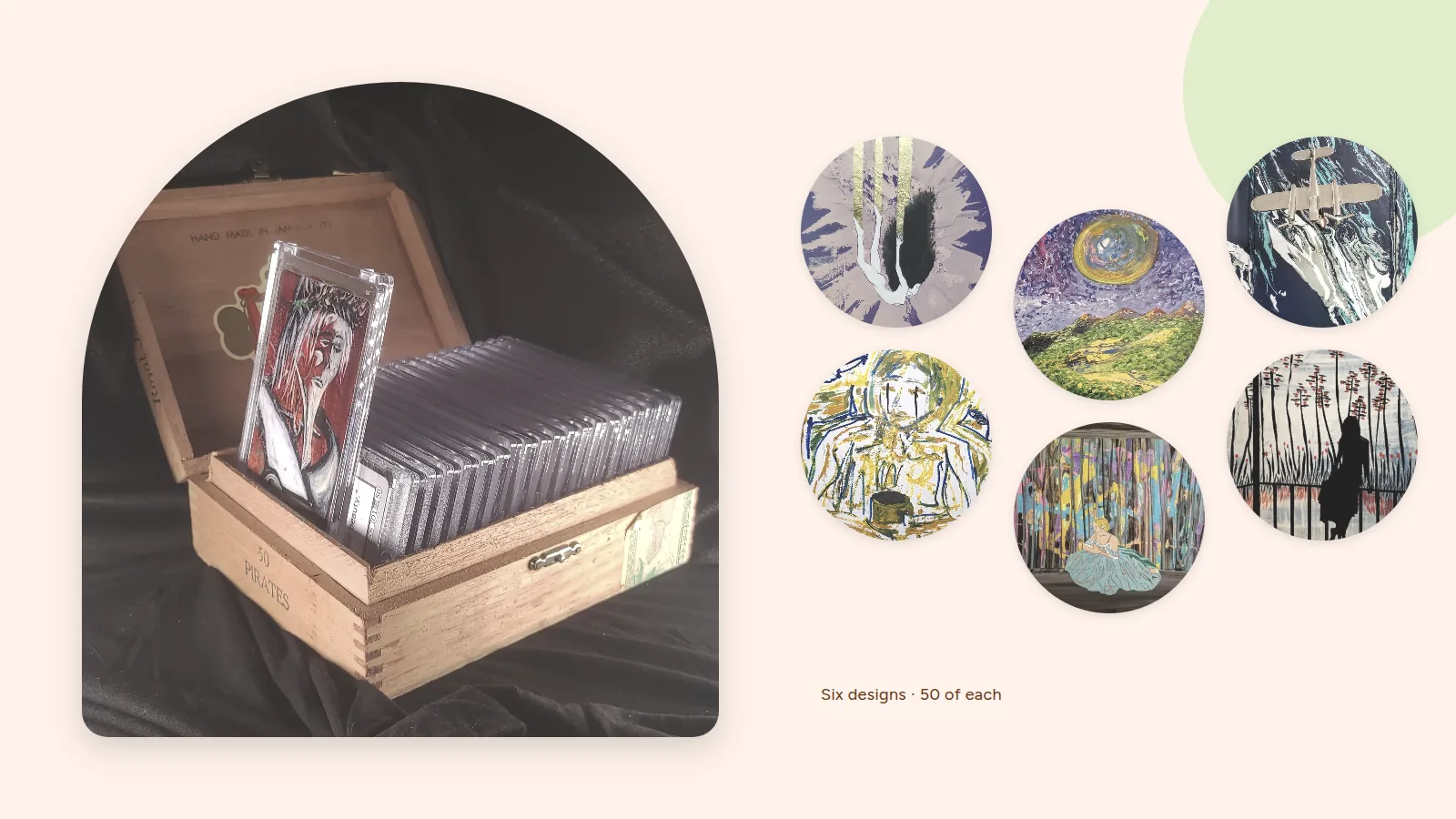
ACEO collecting sits at an unusual intersection: the seriousness of limited edition fine art and the accessibility of something that fits in a card sleeve. The rules that apply to any art collecting — buy what you respond to, verify provenance, understand what scarcity actually means — apply here. The budget doesn't have to.
The format rewards people who are willing to think about collecting as a practice rather than a transaction. A single $45 print from an artist with a growing reputation is worth more as the first in a deliberate collection than as an impulse purchase sitting loose in a drawer. The difference isn't the print. It's the intention behind acquiring it.
Start With the Image, Not the Edition Numbers
The single most reliable mistake new collectors make is buying based on edition rarity rather than the image itself. An edition of 5 from a mediocre painting is still a mediocre painting. An edition of 50 from a genuinely strong work is a genuinely strong work with 49 companions in the world. Edition size shapes value over time, but it doesn't create it. The image does that.
The practical test is blunt: would you want to look at this every day? Not in a hypothetical sense — actually look at it, on your desk or shelf, for years. If the answer is uncertain, wait. The ACEO format's advantage is that the stakes are low enough to take chances, but that doesn't mean every chance is worth taking.
"The number printed on the back of a card isn't decoration. It's the certificate of scarcity. 07 of 50 means exactly 49 other people in the world own a different number of the same edition."
Once you've identified work you genuinely want to look at, then the edition details matter. Look for prints with edition numbers physically on the card, not just claimed in a listing. Look for a documented original source painting. Look for an artist whose practice extends beyond the print being sold — someone with a body of work you can research, not an account that exists only to move product.
What to Look For in an ACEO Edition
Edition Evaluation Checklist
Storage and Display: The Practical Side
The ACEO format's practical advantage is that the entire infrastructure of the trading card collecting world is immediately available to you. Penny sleeves, binders, toploaders, magnetic acrylic cases — all of it fits the 2.5 × 3.5-inch standard exactly, and all of it is inexpensive and widely available.
The choice between storage and display is worth thinking about before you buy, not after.
| Method | Best for | Notes |
|---|---|---|
| Magnetic acrylic case + stand | Active display on desk or shelf | Ships with Minicuration prints; protects while visible; easy to store flat when not on display |
| Penny sleeve + binder | Large collections, long-term storage | The most space-efficient option; standard trading card binder pages hold 9 per page |
| Toploader | Individual cards, rigid protection | Hard plastic sleeve; good for cards you handle frequently or ship |
| Grid wall frame | Wall display of multiple prints | Several frame options designed for trading card-sized art; creates a gallery wall effect at low cost |
| Mini-frame with mat | Single-card wall display | Adds visual weight; requires finding the right mat opening size (2.5 × 3.5 inner dimension) |
The one enemy of all paper-based art is direct sunlight. UV damage is cumulative and irreversible. Under indirect light or behind UV-filtering glass or acrylic, a well-printed ACEO edition remains stable for decades. In a south-facing window for a few years, it won't.
Building a Collection Over Time
The difference between owning a few prints and having a collection is intention. A collection has a logic — an artist, a theme, a period, a set of questions the pieces collectively address. That logic doesn't need to be elaborate. "Everything by this artist" is a logic. "Works that use resin or found materials" is a logic. "Prints where the artist's statement changes how I read the image" is a logic.
What a collection isn't is a random accumulation of things you liked at the moment of purchase. That's fine — there's nothing wrong with buying art you respond to without a larger plan — but it's different from collecting, and it produces different results over time. A deliberate collection is a record of sustained attention. That's what makes it interesting to you and eventually to others.
For ACEO specifically, the format's low individual price point makes it tempting to buy frequently without much deliberation. Resist this. Buying one print you've thought carefully about is better than five impulse purchases. The edition you pass on, then come back to, then buy, means something different than the one you bought in thirty seconds.
Following Independent Artists
The highest-leverage move in ACEO collecting is identifying independent artists early, before their work is widely known, and building a collection of their prints before editions sell out. This is easier to say than to do, but the ACEO format makes it more tractable than traditional art collecting: the prices are low enough to take a chance on artists whose work you find compelling but whose reputation is still forming.
The signals worth paying attention to are consistency of practice, range of work, and the quality of what the artist says about their own work. An artist who can articulate what they're doing and why — in their own voice, without art-world jargon — is usually an artist who knows what they're making. The artist's statement on the back of each Minicuration print exists for exactly this reason: it's evidence of a coherent practice, not just a caption. JFeelgood's current editions — from the gold-leaf figure of Dreamfall to the resin-embedded airplane of Sky Miles — each carry that statement on the back.
When to Buy and When to Wait
Buy when you'd regret the edition selling out. That's a specific feeling, not a general one. If the thought of missing a particular print produces something in you — a specific reluctance, a sense that you'd return to it — that's information. If the main draw is scarcity or FOMO rather than the image, wait. Scarcity that's manufactured for marketing purposes doesn't produce the same relationship with a piece over time as genuine scarcity from a limited edition of something you wanted specifically.
For editions with a small cap — 50 prints from an active artist whose work is getting attention — genuine sell-outs happen. The Minicuration model is explicit about this: 50 editions, no reprints, ever. When edition 50 sells, that print is done. Whether that matters to you depends on how much you want the specific image. The answer to that question is one you should know before you're staring at a sold-out page.
The collection to start with is the one in front of you. Six prints, all available, all $45, all by the same artist, all with the story on the back. That's a coherent starting point. What you build from there is yours.